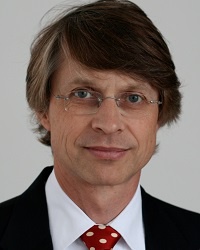
Wolfgang Müller is executive director of the Institute for Free Enterprise (IUF), a privately funded German free-market think tank, and general secretary of the European Institute for Climate and Energy (EIKE), Germany’s major environmentalist "sceptic" group.

Prior to joining the private think tanks, he worked for the classic liberal Friedrich Naumann Foundation for Freedom in Germany, and abroad as project director in Southern Africa and country representative in Zimbabwe. From 1996 to 1998, he undertook an empirical study in India on the impact of deregulation on Indian SMEs. 

Wolfgang Müller studied at the University of Konstanz in Germany and graduated in 1991 with an M.A. in Business Administration/Major: International Relations (Structural Adjustment Programmes in Sub-Saharan Africa). He is member of the Mont Pelerin Society, the Friedrich August von Hayek Society, and serves on the advisory board of the Freedom and Entrepreneurship Foundation in Katowice, Poland.

Recent Articles by Wolfgang Müller

  • Book review, 'Green Tyranny' by Rupert Darwall

    Green Tyranny: Exposing the Totalitarian Roots of the Climate Industrial Complex. Rupert Darwall.
    Encounter Book, 2017. 334 pages.

    The subtitle of Rupert Darwall’s book about "the totalitarian roots of the climate-industrial complex" seems designed to appeal to readers who are already skeptical about current climate change and environmentalist policies. While his book definitely proves the thesis implicit in its title, it is far more than a handbook for “skeptics.” Green Tyranny is a must-read for every person who cherishes freedom and who wants to know how environmentalism could become so powerful that, in some countries, it seems like a new state religion.

    The author intended this book to complement his earlier work, The Age of Global Warming, which was critical of policies and initiatives aimed at fighting climate change. In Green Tyranny, he wanted to focus on continental Europe in general, and Sweden and Germany, in particular.

    In the preface, we learn how Darwall sees Germany:

    German culture harbors an irrational, nihilistic reaction against industrialization, evident before and during the Nazi era. It disappeared after Hitler’s defeat and only bubbled up again in the terrorism and anti-nuclear protests of the 1970s and the formation of the Green Party...